
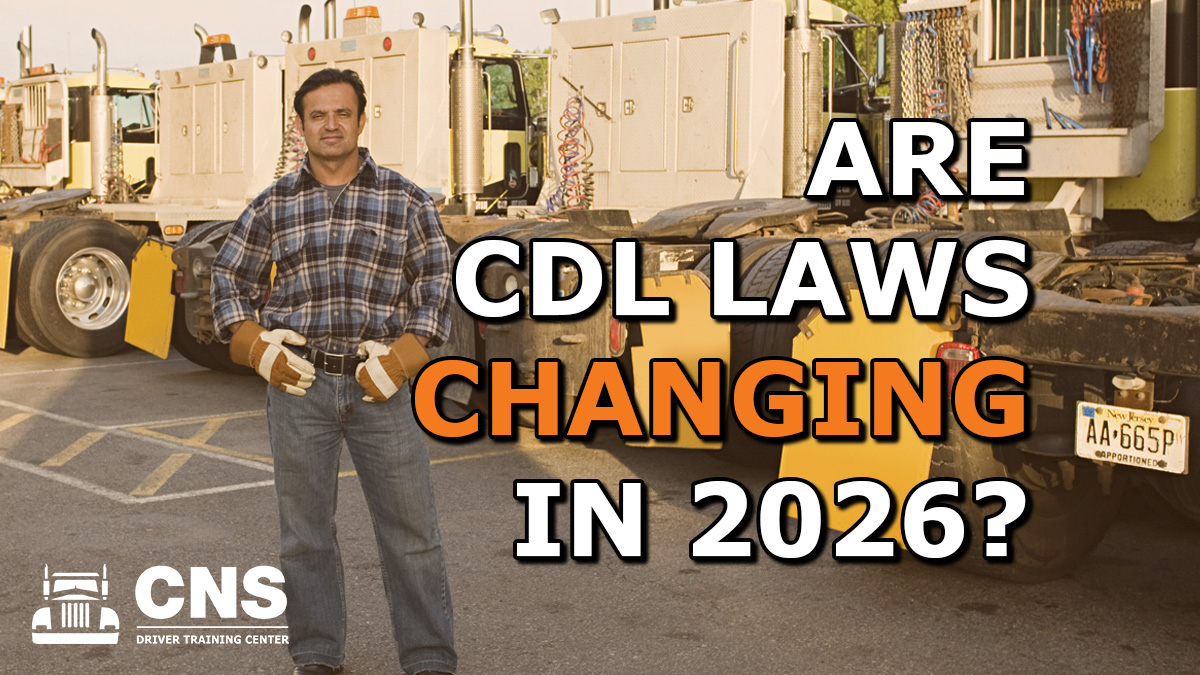
As the trucking industry moves into 2026, major regulatory changes are reshaping how Commercial Driver’s Licenses (CDLs) are issued, verified, and maintained.
For CDL schools, instructors, and future drivers, these updates represent one of the most significant shifts in years, particularly when it comes to non-domiciled CDL holders, Entry-Level Driver Training (ELDT) compliance, and tighter federal oversight of state licensing systems.
The Federal Motor Carrier Safety Administration (FMCSA) has made it clear: licensing integrity and roadway safety are top priorities. That means CDL schools must be prepared to adapt quickly, educate students accurately, and ensure training programs meet stricter federal expectations.
Below is what CDL schools and future drivers need to know about the most impactful CDL law changes heading into 2026.
1. Non-Domiciled CDLs Face the Biggest Overhaul
The most dramatic change for 2026 involves non-domiciled CDLs issued to foreign nationals. FMCSA and state partners are tightening requirements after years of concerns over inconsistent vetting, fraudulent documentation, and uneven state enforcement. States have already paused all non-domiciled CDL and CLP issuance, but the story is far from over.
Under the updated framework, non-citizens seeking to obtain or renew a CDL must demonstrate lawful presence and specific employment authorization. Acceptable visa categories are expected to be limited primarily to:
- H-2A (Temporary Agricultural Workers)
- H-2B (Temporary Non-Agricultural Workers)
- E-2 (Treaty Investors and Employees)
Applicants will be required to present verified documentation such as:
- A valid passport
- I-94 arrival/departure record
- Proof of qualifying visa status
Many existing non-domiciled CDL holders may no longer qualify under these stricter standards, which could significantly reduce the available driver pool.
What does this mean for CDL schools?
For CDL training providers, this change places greater responsibility on front-end screening. Schools should no longer assume that possession of a learner’s permit or prior CDL automatically means eligibility will continue.
CDL schools should:
- Educate prospective students on lawful status requirements before enrollment
- Avoid enrolling students who may be ineligible to test or renew
- Coordinate closely with state licensing agencies to verify documentation standards
Failing to do so could result in dissatisfied students, incomplete training paths, and reputational risk for schools.
2. Increased Enforcement and Federal Oversight
FMCSA is also pressuring states to fully align with federal CDL issuance rules, something that has historically been inconsistent.
By 2026, all states are expected to:
- Fully integrate medical certification processing systems
- Enforce federal verification standards uniformly
- Close loopholes that allowed improperly vetted drivers to obtain CDLs
In addition, agencies like USPS and federal contractors are phasing out non-vetted drivers, increasing scrutiny across the industry. While some legal challenges remain, the overall direction is clear: compliance enforcement is tightening, not loosening.
For CDL schools, this means state-by-state workarounds will no longer be reliable.
3. ELDT Providers Under the Microscope
Entry-Level Driver Training (ELDT) remains a major focus area for FMCSA in 2026. The agency is actively reviewing Training Provider Registry (TPR) participants and removing programs that fail to meet requirements.
Common ELDT compliance issues include:
- Incomplete or inaccurate training records
- Failure to meet behind-the-wheel training standards
- Improper reporting to the FMCSA system
- Inadequate instructor qualifications
What CDL schools must do now: CDL schools should assume audits are coming—even if they’ve never had one before.
Best practices include:
- Regular internal ELDT audits
- Verifying curriculum alignment with FMCSA standards
- Ensuring all completions are reported correctly and on time
- Training instructors on documentation, not just driving skills
In 2026, being listed on the TPR is not enough, remaining compliant is the real challenge.
While removals and notices impacted every state, Pennsylvania saw substantial enforcement activity, but CNS Driver Training Center is Not one of them.
CNS Driver Training Center didn’t just “pass” federal scrutiny, we demonstrated what good training looks like to state leaders, policymakers, and industry partners.
Are you a future driver? If you want CDL training that is:
- Safe
- Compliant
- Career-ready
- One-to-one
- Backed by real results
- Recognized by industry and government leaders
Choose CNS Driver Training Center. If you have questions about our CDL training packages, give us a call at 717-496-9145 or email us at support@cnstrains.com.
Not sure where to start? Enroll in our FREE CDL Permit Prep Course for expert study help and test preparation.
4. Carrier Safety Ratings and Continuous Monitoring
Another major shift expected in 2026 is FMCSA’s move toward continuous carrier monitoring, rather than relying primarily on infrequent compliance audits.
This shift emphasizes:
- Real-time data from inspections, crashes, and violations
- Ongoing driver qualification compliance
- Faster intervention for high-risk carriers
For future CDL school students, this reinforces an important message: compliance doesn’t stop after licensing. Schools that incorporate compliance education into training, not just skills testing, will better prepare drivers for long-term success.
5. What This Means for Future Drivers
Documentation will matter more than ever, futuredrivers should expect:
- Increased scrutiny of identity and lawful status
- Tighter return-to-duty (RTD) processes for drug and alcohol violations
- Fewer shortcuts when it comes to CDL issuance or renewal
Higher costs and tighter labor pools, carriers may face:
- Increased recruiting and training costs
- Higher insurance premiums
- Smaller, more thoroughly vetted driver pools
From a CDL training perspective, this places CDL schools at the center of the solution, preparing qualified, compliant drivers from day one.
Future drivers should look for a well-reviewed CDL school for their training.
At CNS Driver Training Center, staying ahead of regulatory change is part of the mission. If you have questions about our CDL training packages, give us a call at 717-496-9145 or email us at support@cnstrains.com.