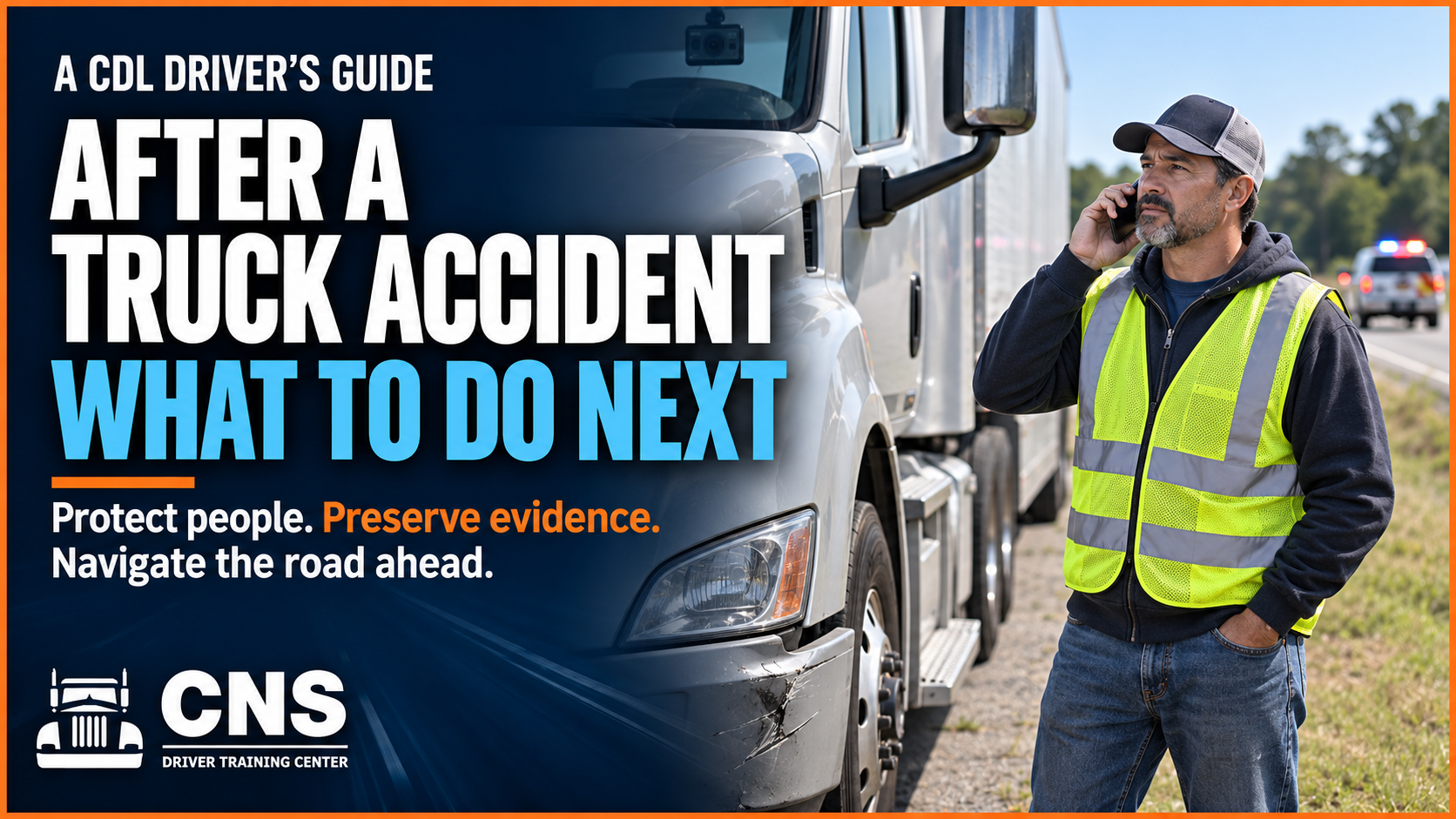
A serious crash can affect your health, your CDL, your career, and the people involved. Knowing what to do, and how to work with your company, can help you navigate what follows.
You may have driven safely for decades. Then, in a matter of seconds, you are standing beside a damaged truck, emergency lights are approaching, and someone may be seriously hurt.
Your first responsibility is protecting people. But the decisions that follow also matter: how you report the crash, what you say, whether evidence survives, and whether you receive the medical and legal support you need.
A trucking accident can lead to several separate processes: a police investigation, an insurance claim, a company safety review, a regulatory investigation, and potentially a lawsuit naming both you and your employer.
You DO NOT have to manage all of that alone. You DO need to understand your role.
1. Protect people and prevent another collision
Stop, secure the truck, and assess immediate danger. Activate your hazard lights, set the parking brakes when stopped, and call 911. Give the dispatcher your roadway, direction of travel, nearest exit or mile marker, and what you know about injuries, blocked lanes, fire, or leaking cargo.
Follow emergency instructions about moving the vehicle. Whether it should be moved depends on the danger, vehicle condition, applicable law, and instructions from responders. Do not move an unsafe truck simply to keep a delivery moving.
If you can safely assist someone, provide help within your training. Follow the 911 dispatcher’s instructions. Avoid moving an injured person unless necessary to escape immediate danger.
Remember that passing traffic can create a second emergency. Wear reflective clothing when available, avoid standing between vehicles, and stay out of travel lanes.
Place warning devices correctly
For a CMV stopped on a highway or shoulder outside a necessary traffic stop, federal rules generally require immediate hazard flashers and warning devices as soon as possible, within 10 minutes. Typical triangle placement is:
| Roadway | General placement |
| Two-way, undivided road | One approximately 10 feet away on the traffic side toward approaching traffic; one approximately 100 feet toward approaching traffic; one approximately 100 feet in the opposite direction. |
| Divided or one-way highway | One within 10 feet of the rear on the traffic side; the others approximately 100 and 200 feet behind the truck toward approaching traffic. |
| Hill, curve, or other obstruction within 500 feet | Adjust the device toward the obstruction to a location 100-500 feet away that gives approaching motorists adequate warning. |
Special rules and exceptions apply. Devices belong in the lane or shoulder occupied by the truck as specified by the regulation; do not arrange them diagonally across adjacent lanes to direct traffic. Flame-producing devices also present restrictions around leaking flammable materials.
If injuries or immediate danger prevent you from placing devices, tell responders and your company. Do not enter an active traffic lane to obtain a photograph or retrieve debris.
For hazardous materials, identify the load and shipping papers to responders, follow your emergency training, and keep people away from the hazard. Do not attempt an unfamiliar spill cleanup.
2. Notify your company and ask for specific support
Once emergency help is underway, contact your company’s designated accident number or safety department. Report every collision under company policy, including incidents that initially appear minor.
Give a clear, factual report:
- Your location and a callback number.
- Whether anyone appears injured or has been transported.
- Whether vehicles are blocking traffic or require towing.
- Whether there is fire, spilled fuel, or damaged cargo.
- Which police agency is responding.
- Whether you received a citation.
- Whether the truck has cameras and whether footage needs immediate preservation.
- Whether you need medical care, transportation, or someone to stay on the phone with you.
Avoid guessing about fault or injury severity. “An ambulance transported the other driver” is more useful than “They probably aren’t hurt.”
Ask the company to identify one person coordinating your response. That person should help arrange testing when required, notify claims personnel, preserve electronic records, coordinate recovery, and explain your next steps.
Before ending the call, confirm:
Where should I go? Who is arranging transportation? Is testing required? Who is preserving the camera footage? Who will contact me next?
If the first person does not answer, follow the escalation list. Keep a record of your attempts and continue addressing emergency needs.
3. Be truthful, calm, and careful about statements
After a frightening crash, it is natural to explain, apologize, or fill uncomfortable silence. Resist the urge to reconstruct events before you know what happened.
Provide required identification, insurance, and crash information. Cooperate with lawful instructions. When describing events, distinguish between what you observed and what you assume.
For example:
- “I saw the car enter my lane” describes an observation.
- “The driver was texting” is speculation unless you actually saw it.
- “I don’t know” or “I don’t remember that detail” is appropriate when true.
You can show concern: “Is anyone hurt? Help is on the way.” You do not need to decide legal responsibility at the roadside.
Do not lie, conceal relevant facts, or give a rehearsed account that does not match your memory. If you later realize that you gave incorrect information, promptly tell the appropriate company contact and counsel so it can be addressed accurately.
Avoid roadside arguments, promises that your company will pay, private settlement offers, or signing another party’s statement or release without appropriate advice. Do not pressure anyone to admit fault or sign an “exoneration” form.
For a serious injury, fatality, or possible criminal investigation, promptly request legal assistance before a detailed investigative interview. Asking for counsel does not eliminate identification, reporting, testing, or other legal obligations.
Direct media questions to your company’s designated spokesperson. Do not speculate for a reporter or post your account online.
4. Document what you safely can
Your job is to preserve useful observations. Investigators can perform measurements and reconstruction later.
If you are medically able and the scene is safe, photograph:
- Overall vehicle positions before movement, when possible.
- Damage to each vehicle and identifying information.
- Road markings, signs, signals, intersections, and lane configuration.
- Visible tire marks, debris, road hazards, and lighting conditions.
- Your truck, trailer, load, and warning-device placement.
Take wide views as well as close-ups. Preserve the original files rather than keeping only cropped, filtered, or annotated versions.
Collect the other parties’ names, contact information, vehicle details, and insurance information as required. Ask willing witnesses for names and phone numbers. Record the responding agency, officer information, and crash report number.
Write factual notes as soon as reasonably possible. Include what you observed before impact, your actions, and anything you could not see. Identify estimates as estimates. If someone makes a relevant statement, record their words accurately and identify who said them.
Do not photograph injured or deceased people for your accident report, walk into traffic to measure skid marks, collect vehicle fragments, or disturb potential evidence. Tell investigators where important evidence is located.
If you suspect a staged collision, report the specific observations to police and your company. Avoid confronting or accusing people at the scene.
5. Confirm whether post-accident testing is required
A DOT-recordable crash and a DOT testing requirement are separate determinations.
The federal accident definition generally covers a qualifying CMV crash involving a fatality, an injury requiring immediate medical treatment away from the scene, or disabling damage requiring a vehicle to be transported away. Your company must assess applicable recordkeeping requirements; that classification does not determine fault.
For drivers covered by Part 382, federal post-accident testing generally works as follows:
| Crash circumstances | DOT testing requirement |
| Human fatality | Alcohol and controlled-substances testing required for the surviving covered driver, regardless of citation, subject to the testing windows. |
| Injury with immediate medical treatment away from the scene | Testing required when the CMV driver receives a qualifying moving-violation citation within the applicable window. |
| Disabling damage requiring any involved vehicle to be transported away | Testing required when the CMV driver receives a qualifying moving-violation citation within the applicable window. |
The citation window is 8 hours for alcohol and 32 hours for controlled substances. A tow by itself does not automatically trigger DOT testing.
Required tests must occur as soon as practicable. If alcohol testing has not occurred within two hours, the employer must document the delay. Attempts stop at eight hours for alcohol and 32 hours for controlled substances, with required documentation. Stay readily available, but necessary emergency medical care must not be delayed.
Tell your company immediately if you receive a citation after leaving the scene. For example, a qualifying citation issued 10 hours after an injury crash may trigger controlled-substances testing within the remaining window; it does not reopen the expired alcohol-testing window.
Ask where testing will occur, who is arranging transportation, and whether it is DOT testing or a separate company-policy test. Do not assume ordinary emergency-room bloodwork satisfies DOT requirements.
If you are required to take a post-accident alcohol test, federal rules prohibit alcohol use for eight hours after the crash or until that test occurs, whichever comes first. Other duty-related alcohol restrictions still apply.
6. Preserve your phone, footage, and records
Some of the most important evidence may never appear in a roadside photograph.
Relevant material can include dashcam footage, ELD records, GPS data, dispatch messages, call records, inspection reports, fuel receipts, bills of lading, and maintenance communications.
Tell your company immediately which devices and accounts contain relevant information. Ask it to preserve footage from before, during, and after the collision, including available camera views.
For your own devices:
- Do not delete messages, call history, photographs, videos, or relevant posts.
- Do not reset, trade in, or discard a phone that may contain evidence without guidance from counsel.
- Ask how to suspend automatic deletion and preserve relevant accounts.
- Preserve records even if they appear unfavorable.
- Do not change logs or inspection records to make them match a preferred account.
If a genuine record error needs correction, use the authorized process, retain the original history, and explain the correction accurately.
A preservation notice or litigation hold means relevant information must be retained. The duty can arise before a lawsuit is filed. Losing evidence can lead to court remedies or sanctions; the consequences depend on the governing law and circumstances. Federal Rule 37(e), for example, distinguishes prejudicial loss of electronic information from intentional destruction intended to deprive another party of its use.
Preservation means keeping the record accurate and complete.
7. Coordinate towing and inspection without disturbing evidence
The truck itself may hold evidence about braking, tires, lights, vehicle condition, and electronic events.
Give your company the towing operator’s name, destination, and contact information. Tell responders and recovery personnel about known cargo hazards or vehicle dangers.
Follow lawful recovery directions, but do not independently authorize non-emergency repairs, component disposal, data clearing, or salvage. Notify your company so its claims team and counsel can coordinate preservation and inspections.
Avoid attempting your own electronic download or removing a camera card unless you are trained and following an established procedure.
Before returning to driving, confirm the vehicle is safe, required inspections or releases are complete, and you are fit to operate. A delivery deadline does not resolve those questions.
8. Understand why the investigation may reach beyond the crash
If a claim develops, attorneys may examine whether your actions contributed to the collision and whether the company properly hired, trained, supervised, and equipped you.
Depending on the issues, questions may involve:
- Your qualifications, CDL restrictions, and relevant training.
- Your work hours, rest, and other employment.
- Phone use, speed, following distance, and camera events.
- Vehicle inspections, reported defects, and repairs.
- Load securement and trip planning.
- Dispatch instructions and pressure to continue in unsafe conditions.
That is why records created before the accident can matter afterward.
If you reported a brake concern, fatigue, or an unsafe schedule, identify the actual communication. If you made a mistake, tell your attorney accurately. Do not ask coworkers to align their stories, recreate missing paperwork as though it existed earlier, or backdate training.
Also keep different decisions separate. A company’s “preventable” finding, a police citation, an insurance decision, and a court’s liability ruling answer different questions.
For eligible crashes, ask your company about FMCSA’s Crash Preventability Determination Program. Drivers and carriers can submit supporting evidence through DataQs. A not-preventable finding can affect how the crash is treated in federal safety systems, but it does not decide civil fault or legal liability.
9. Clarify who represents you
Your employer, insurer, claims adjuster, and defense attorney have different roles.
Ask directly:
“Does this attorney represent me personally, the company, or both?”
A lawyer representing an organization does not automatically represent every employee. Joint representation may be possible, but conflicts can arise.
Get clarity about representation if you are personally named in a lawsuit, face possible criminal charges, receive a coverage warning, or believe your interests and the company’s interests differ.
Be candid with the attorney who represents you. Ask which communications are confidential and who should receive information. Do not assume an ordinary conversation with dispatch or a safety manager is legally privileged simply because it concerns a crash.
For an unfamiliar investigator or caller, obtain their name, organization, contact details, and who they represent. Coordinate requests for detailed interviews or recorded statements with your claims contact and attorney. Continue meeting applicable cooperation duties and lawful requirements.
10. Know what to do if a claim becomes a lawsuit
A claim may resolve through insurance negotiations, or it may lead to litigation. A civil lawsuit generally begins with a complaint and service of legal papers. Discovery can include document requests, written questions, and depositions before any trial. Many cases resolve without a trial.
Your responsibilities are practical:
- Forward papers immediately. Send summonses, complaints, subpoenas, preservation letters, and settlement demands to the designated company contact and your attorney. Preserve the originals and note when and how you received them. Do not assume someone else received a copy.
- Keep your contact information current. Your involvement may continue after you change employers.
- Prepare carefully for testimony. Review relevant records with your attorney. At a deposition, listen to the full question, ask for clarification, and answer truthfully. Separate what you remember from what a document shows. Do not guess or memorize a story.
- Keep the case off social media. Avoid crash commentary, livestreams, private-group discussions, or arguments with people involved. If you have already posted something relevant, preserve it and tell counsel rather than deleting it.
- Do not negotiate personally with the injured party or family. Route settlement discussions through the authorized claims and legal team. Compassion matters, but personal promises or direct contact can complicate the process.
11. Take your physical and emotional recovery seriously
Tell medical professionals about symptoms and follow their instructions. Notify your company about work restrictions and ask how to report a work-related injury.
A serious crash can also leave you struggling with sleep, concentration, fear, or distress. Tell an appropriate healthcare professional and ask your employer about available support.
Be specific with safety personnel: “I am shaking and cannot concentrate enough to drive safely” communicates more than “I’m having a bad day.”
Federal rules prohibit driving and prohibit a carrier from requiring or permitting driving when fatigue, illness, or another cause impairs the driver enough to make operation unsafe.
Arrange transportation if you cannot safely drive. Return-to-work decisions should account for your condition, medical restrictions, and applicable qualification requirements.
Prepare before the next trip
Every driver should know the company’s crash procedure before needing it.
Keep emergency contacts, required documents, an accident-report form, reflective gear, a flashlight, and a charged phone accessible. Check required emergency equipment during your inspections.
Ask your company to practice the process with you: placing triangles, reporting a crash, preserving camera footage, arranging after-hours testing, and reaching someone when dispatch does not answer.
A serious accident may leave you with uncertainty for a long time. A practiced response gives you concrete actions when it is hardest to think clearly.
Need an insurance or compliance consultation?
At CNS, we’re your partner in navigating the complexities of the trucking industry. Whether you’re looking to reduce insurance costs, enhance coverage, or ensure compliance, we’re here to help you every step of the way.
Call us at 888.260.9448 or email info@cnsprotects.com.
This guide provides general safety and compliance information. State laws, reporting duties, and legal procedures vary. Obtain advice from qualified counsel for a specific crash or claim.