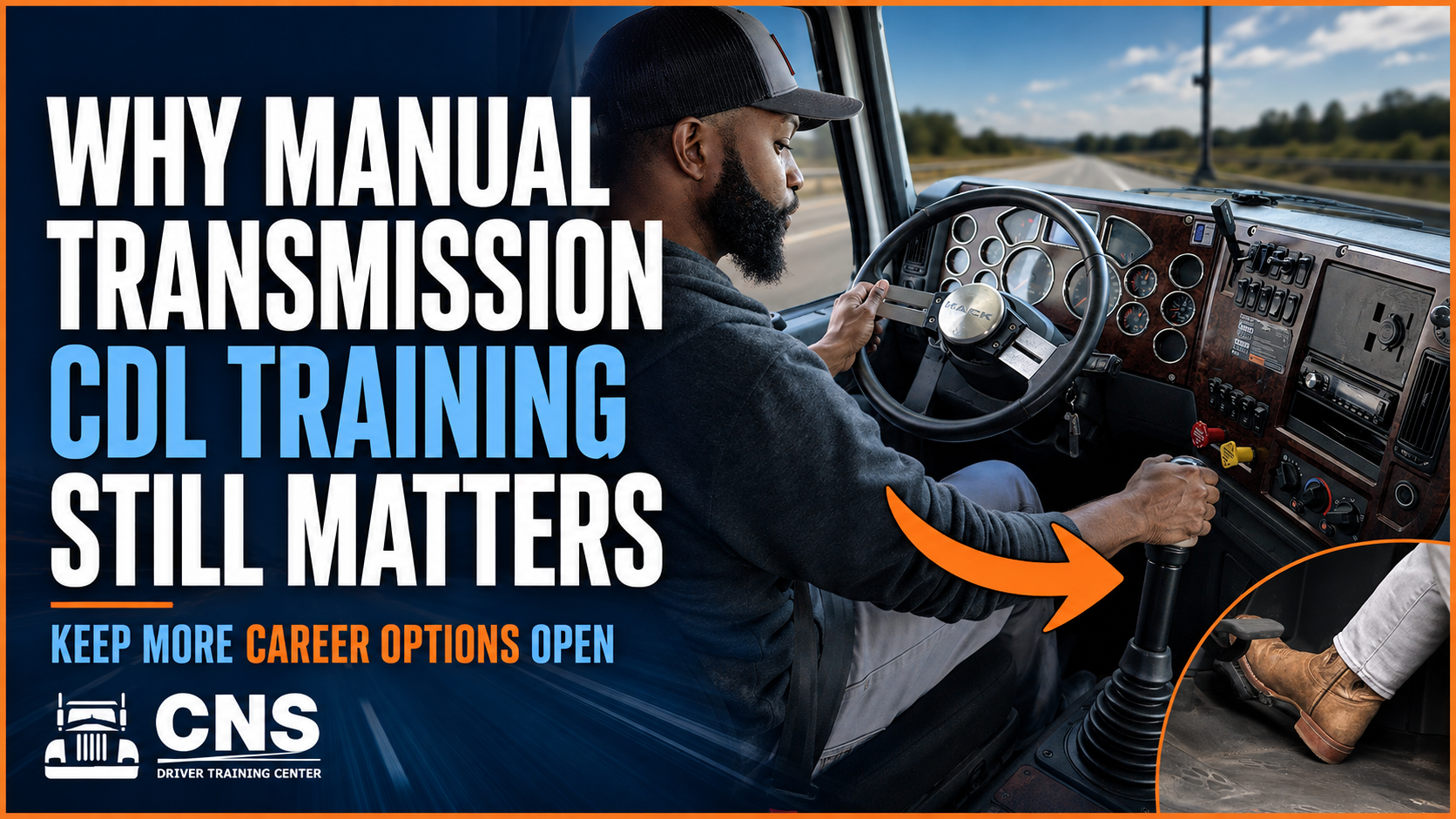
Why Manual Transmission CDL Training Still Matters
Automatic transmissions have become increasingly common in commercial trucks, and many CDL schools have adjusted by training students exclusively on automatic equipment.
For CDL schools, automatic trucks can make training simpler. Students do not need to spend as much time learning clutch control, shifting patterns, downshifting, or how to recover from a missed gear. This can make it easier to move students through a standardized training program.
But what is convenient for the CDL school may not be the best choice for the student—or for the employer who needs drivers capable of operating different types of equipment.
If you complete your CDL skills test in a truck with an automatic transmission, your commercial driver’s license will include a restriction prohibiting you from operating a commercial motor vehicle equipped with a manual transmission. In Pennsylvania, this is identified as an E restriction.
That restriction can follow you throughout your career and prevent you from accepting jobs that involve manual-shift trucks.
At CNS Driver Training Center, students can train on both manual and automatic commercial vehicles. This gives drivers and employers more flexibility when choosing the training that fits their needs.
What Is the E Restriction on a CDL?
Federal regulations require states to place a manual-transmission restriction on the CDL of an applicant who completes the skills test in a vehicle equipped with an automatic transmission.
Under 49 CFR § 383.95, a driver who tests in an automatic-transmission commercial motor vehicle is prohibited from operating a commercial motor vehicle with a manual transmission.
Pennsylvania identifies this limitation with the restriction code:
E – Prohibits driving a commercial motor vehicle equipped with a manual transmission.
This does not mean the driver has an invalid CDL. The driver can still operate vehicles within the appropriate CDL class, endorsements, and other restrictions. However, every commercial vehicle the driver operates must have an approved automatic transmission.
A driver who completes the required training and skills test in a manual-transmission truck can generally operate both manual and automatic commercial vehicles, provided the driver meets all other licensing and endorsement requirements.
Why Are So Many CDL Schools Using Automatic Trucks?
There are understandable reasons why CDL schools have moved toward automatic equipment.
Automatic trucks can be easier for new students to learn. Instructors can spend less time teaching shifting, clutch control, and gear selection. Students may also feel more confident when they do not have to coordinate the clutch, accelerator, transmission, traffic, and trailer at the same time.
Automatic equipment may help schools:
- Reduce the time spent teaching shifting techniques
- Simplify training for inexperienced drivers
- Standardize instruction across different students
- Reduce wear on clutches and manual transmissions
- Prepare students for larger fleets that primarily use automatic trucks
For some drivers, automatic-only training may be sufficient. If a student already has a confirmed job with a carrier operating an entirely automatic fleet, the E restriction may not immediately affect that driver.
The problem is that many students choose a CDL school before they know where their careers will take them.
A driver’s first employer may use automatic trucks, but the next employer may not. A future opportunity in flatbed, tanker, construction, agriculture, towing, heavy hauling, specialized transportation, or a smaller private fleet could involve manual equipment.
A CDL is a career credential. Students should understand how their choice of training vehicle can affect that credential long after graduation.
The Trucking Industry Has Not Eliminated Manual Transmissions
Newer over-the-road fleets have adopted automatic and automated-manual transmissions in large numbers. However, manual-transmission trucks have not disappeared.
Manual equipment can still be found in:
- Flatbed and specialized hauling fleets
- Tanker operations
- Construction and excavation companies
- Agricultural and feed operations
- Heavy-haul and vocational fleets
- Towing and recovery companies
- Smaller trucking companies
- Private fleets with older equipment
- Seasonal or spare fleet vehicles
- Owner-operator businesses
Not every company in these industries uses manual trucks. However, employers that maintain even a few manual vehicles need drivers who are legally qualified—and practically prepared—to operate them.
A driver with an E restriction cannot simply get behind the wheel of a manual truck because an employer needs help that day. The restriction legally prohibits the driver from operating that vehicle.
An Automatic-Only CDL Can Reduce Your Employment Options
Many new drivers assume that once they earn a Class A CDL, they will be qualified for every Class A driving position.
That is not always true.
CDL class, endorsements, and restrictions all determine what a driver may legally operate. A Class A CDL with an E restriction is different from an unrestricted Class A CDL when an employer uses manual-transmission trucks.
This can create several career limitations.
You May Be Disqualified From Certain Jobs
An employer may require applicants to have no manual-transmission restriction, even if most of its current vehicles are automatic. The company may still have manual trucks in its fleet or may need drivers to move, recover, or temporarily operate different equipment.
You May Have Less Flexibility During a Job Search
A driver looking for work may find a great local, regional, or specialized position—only to discover that the assigned truck has a manual transmission.
The E restriction can remove that opportunity before the employer even evaluates the driver’s experience.
You May Have Fewer Options During a Layoff or Career Change
A driver’s equipment needs can change over time. A company may close, reduce routes, change contracts, or sell part of its fleet. Drivers with broader qualifications have more options when they need to find another position quickly.
You May Need Additional Training and Testing Later
Removing an E restriction is more involved than simply asking the licensing agency to change the CDL.
Drivers generally need to demonstrate their ability to operate a manual-transmission commercial vehicle through the applicable state testing process. Depending on the driver’s situation and state requirements, this can involve obtaining the appropriate permit, securing a manual vehicle, completing additional training, and passing another skills test.
Learning on manual equipment during your original CDL training may help you avoid the additional time, expense, and inconvenience of removing the restriction later.
Manual Transmission Training Builds More Than Shifting Skills
Learning to drive a manual commercial vehicle is not just about moving a gear selector.
Students must learn how engine speed, road speed, vehicle weight, grade, traffic conditions, and gear selection work together. They also need to develop coordination and sound decision-making while controlling a much larger vehicle.
Manual CDL training can help students develop skills such as:
- Smooth clutch engagement
- Proper upshifting and downshifting
- Selecting the correct gear for road conditions
- Avoiding missed shifts and gear grinding
- Recovering safely when a shift is missed
- Managing speed on hills and grades
- Understanding engine RPM and vehicle response
- Maintaining control while approaching turns and stops
- Dividing attention between shifting, mirrors, traffic, and the trailer
These skills require practice. Students learn at different speeds, which is one reason the training format matters.
Why One-on-One Manual CDL Training Makes a Difference
Manual-transmission training can be frustrating when several students are sharing the same truck and instructor.
One student may need additional practice with clutch control, while another may need help with downshifting or approaching intersections in the correct gear. In a group-based program, students can spend a significant amount of time watching other people drive instead of building their own skills.
CNS Driver Training Center uses a one-on-one behind-the-wheel training model. Students receive individualized time with an instructor who can identify specific problems and adjust the training accordingly.
That may include helping a student:
- Find and understand the clutch’s engagement point
- Improve timing between the clutch and gear selector
- Recognize when to shift based on engine RPM
- Prepare for stops without losing control of the transmission
- Build confidence in traffic
- Correct habits before they become difficult to change
Students are not expected to master a manual truck immediately. The goal is to build competence through focused instruction and repeated, supervised practice.
CNS Trains on Both Manual and Automatic Equipment
CNS Driver Training Center recognizes that different students and employers have different needs.
That is why we maintain training options involving both manual and automatic commercial vehicles.
A student may choose automatic training because a confirmed employer operates an automatic fleet and does not require manual qualification. Another student may choose manual training because they want the broadest possible range of future employment opportunities.
Our team helps students understand the difference before they commit to a training path.
This is important because many regional CDL schools train exclusively on automatic equipment. Students may not realize they are accepting a license restriction until they are already enrolled—or until they begin applying for jobs.
At CNS, manual transmission training is not treated as an outdated skill. It is an employment option that can help keep more career doors open.
Manual CDL Training for Employers
The manual-transmission issue also affects companies that sponsor CDL training or hire entry-level drivers.
Employers should not assume that every Class A CDL holder can operate every Class A vehicle in the fleet. Before assigning equipment, companies should review each driver’s license for restrictions, including the E restriction.
For employers operating manual-shift trucks, automatic-only CDL schools can create a recruiting problem. A candidate may complete CDL school and pass the test but still be unable to operate the company’s available equipment.
CNS can work with employers that need training aligned with their fleet, including companies operating:
- Manual-transmission tractors
- A combination of manual and automatic trucks
- Older commercial equipment
- Specialized or vocational vehicles
- Equipment that requires additional driver familiarity
Training drivers on equipment that reflects the employer’s actual operation can reduce surprises after hiring and help new drivers arrive better prepared for company-specific instruction.
Questions to Ask Before Choosing a CDL School
Before enrolling, ask the school specific questions about its training vehicles and testing process.
- Do you offer behind-the-wheel training in a manual-transmission truck?
- Will I complete my CDL skills test in a manual or automatic vehicle?
- Will my CDL have an E restriction after I graduate?
- How much individual driving time will I receive?
- Will I learn clutch control, upshifting, and downshifting?
- Can the school customize training for an employer’s equipment?
- What happens if I need more time to become comfortable shifting?
Do not assume that a school advertising “Class A CDL training” offers manual-transmission instruction. Ask before signing an enrollment agreement or paying tuition.
Is Manual Transmission CDL Training Right for You?
Manual training may be the better choice if:
- You have not selected an employer yet
- You want to keep the widest range of job options available
- You are interested in flatbed, tanker, construction, agriculture, towing, heavy haul, or specialized work
- You may drive for a smaller or private fleet
- Your employer operates manual trucks
- You want to avoid the E restriction
- You may become an owner-operator and want more equipment choices
Automatic training may still make sense for a driver with a firm job offer from an automatic-only fleet. The important thing is to make that decision with a clear understanding of the restriction and its possible long-term effects.
Do Not Let Your CDL School Limit Your Career
Automatic trucks are an important part of today’s transportation industry, but they are not the entire industry.
Choosing an automatic-only CDL school may help you pass the skills test without learning to shift. It can also place an E restriction on your license and prevent you from operating manual commercial vehicles.
CNS Driver Training Center gives students another option.
With manual and automatic equipment, one-on-one behind-the-wheel instruction, and training designed around individual students and employer needs, CNS can help drivers prepare for more than the test. We help them prepare for the equipment and opportunities they may encounter throughout their careers.
Want to earn a CDL without unnecessarily limiting your future job options? Contact CNS Driver Training Center to discuss manual and automatic CDL training in Lititz, Pennsylvania.