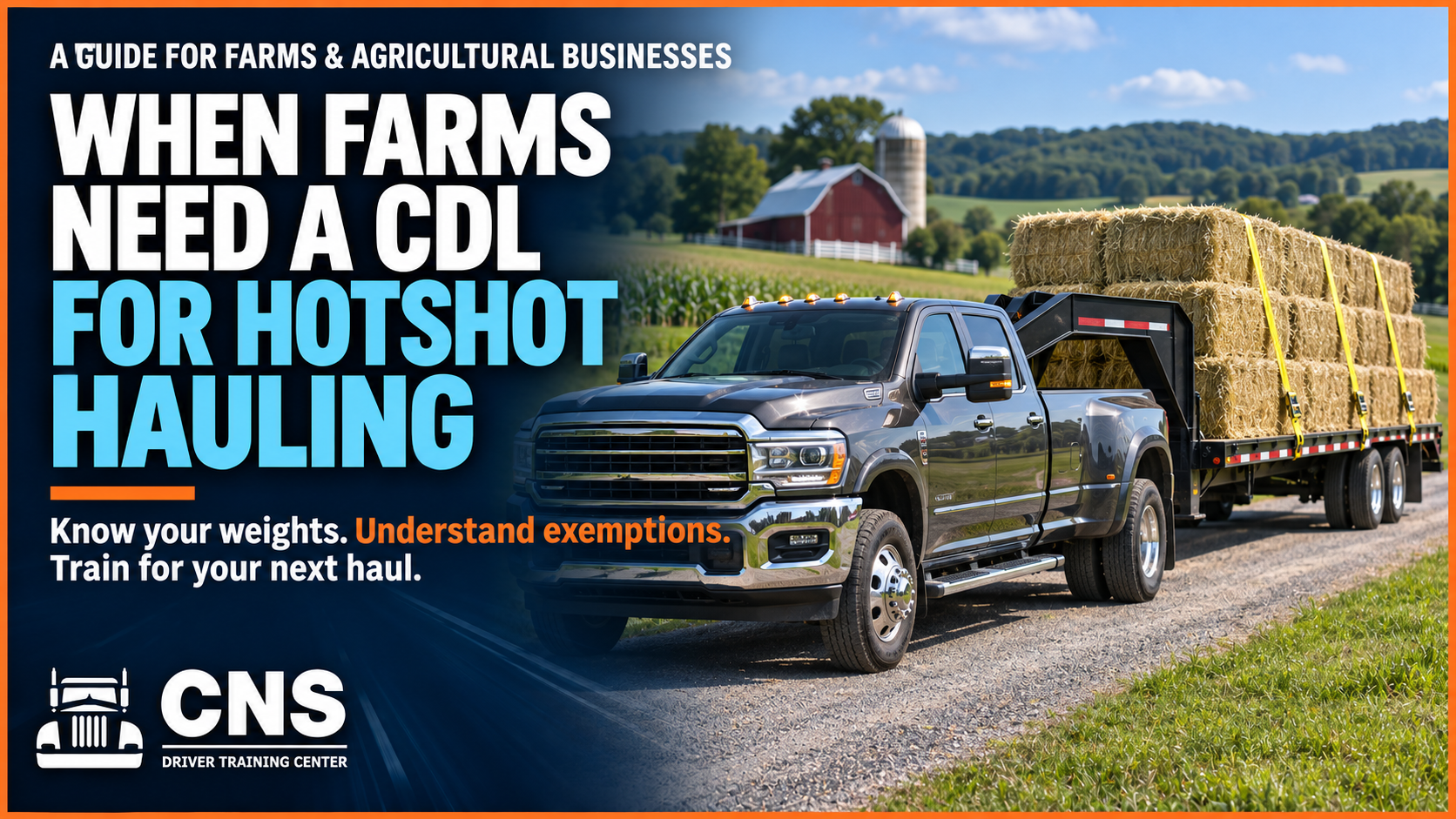
A practical guide to pickup trucks, gooseneck trailers, farm exemptions, and choosing the right training for your agricultural business.
Moving cattle, delivering hay, or bringing home a tractor can put your farm’s pickup-and-trailer combination into Class A CDL territory. A qualifying farm exemption may remove that requirement, but owning a farm does not automatically exempt every trip.
The answer depends on your equipment’s weight, who is driving, what you haul, where you travel, and whether you provide hauling services for others.
Here’s what you need to know.
Start with the truck and trailer weights
“Hotshot CDL” describes training for pickup-and-trailer operations. It is not a separate federal license class. For ordinary property hauling, a Class A CDL generally applies when both conditions are met and no exemption applies:
- The gross combination weight rating or actual gross combination weight, whichever is greater, is at least 26,001 pounds.
- The towed unit’s gross vehicle weight rating or actual gross vehicle weight, whichever is greater, exceeds 10,000 pounds.
A pickup with a 14,000-pound GVWR pulling a trailer with a 14,000-pound GVWR reaches 28,000 pounds in combined ratings and meets the Class A weight thresholds. An empty trailer does not erase its rating. Check certification labels and applicable combination ratings as well as actual weights; the federal GCWR definition includes a calculation using the truck and trailer ratings or actual weights.
A trailer over 10,000 pounds alone does not automatically mean Class A; the combination threshold also matters. A heavy straight truck may require Class B, while placard-required hazardous materials can trigger CDL requirements regardless of vehicle size.
When the covered farm vehicle exemption applies
Federal rules exempt qualifying covered farm vehicles and their operators from CDL requirements. The vehicle must:
- Have the required state-issued farm plate or designation.
- Be operated by the farm or ranch owner or operator, an eligible family member, or an employee.
- Transport agricultural commodities, livestock, machinery, or supplies to or from a farm or ranch.
- Meet the restriction against for-hire operations and not transport hazardous materials requiring placards.
Farm employees can qualify. Paying an employee wages to drive the farm’s truck does not, by itself, make the haul for hire. The vehicle and trip must still satisfy the exemption’s conditions.
The federal operating area depends on the greatest applicable vehicle or combination rating or actual weight:
- 26,001 pounds or less: qualifying operations may use the federal exemptions anywhere in the United States.
- More than 26,001 pounds: qualifying operations may use the exemptions throughout the state of registration, or across state lines within 150 air miles of the farm or ranch.
Air miles measure straight-line distance, not road mileage. Notice that this exemption’s 26,001 pound dividing line differs from the ordinary CDL threshold.
Commercial hauling and for hire are different
A farm transporting its own products or equipment for business purposes can be a private motor carrier. That transportation is not automatically personal just because the farm owns the load. Federal and Pennsylvania definitions describe for-hire transportation as moving goods or passengers for compensation.
For example, an employee delivering hay produced and sold by the employer’s farm may qualify for the farm exemption. Payment for the hay does not automatically make the delivery a for-hire hauling service. Accepting a fee to transport another business’s equipment is a different operation.
Federal rules specifically exclude a qualifying tenant’s transportation of the landlord’s crop share under a crop-share lease from the for-hire prohibition.
Three situations that change the answer
Moving your own tractor between farm properties. An eligible driver using a properly identified farm combination may qualify for the covered farm vehicle exemption.
Accepting a paid hauling job for another business. The covered farm vehicle exemption is unavailable for that for-hire operation. If the combination meets Class A thresholds, a Class A CDL is required unless another specific exemption applies.
Buying equipment several states away. A combination above 26,001 pounds that travels outside its registration state and beyond the 150-air-mile farm radius cannot rely on the covered farm vehicle exemption for that operation. Review CDL and other requirements before arranging pickup.
Pennsylvania licensing and registration rules
Pennsylvania allows a driver with a valid Class A, B, or C license to operate a qualifying Pennsylvania covered farm vehicle anywhere within the Commonwealth without a CDL. An eligible employee with a regular Class C license may therefore operate a qualifying heavy farm combination under 75 Pa.C.S. §§ 1504(d.1) and 1606(b)(5).
Pennsylvania also provides a CDL exemption for appropriately licensed drivers operating covered farm vehicles from other states within 150 air miles of their out-of-state farm.
Registration is a separate question. Pennsylvania farm-plated vehicles are restricted to authorized uses, including qualifying trips between farms and trips involving agricultural purchases or sales. PennDOT states that registered farm vehicles have no distance limitation under those registration rules; that does not expand the federal exemption’s out-of-state operating area.
Vehicles using a farm registration-exemption certificate have category-specific conditions. Some categories restrict distance or travel to daylight hours. Check the plate or certificate rules before the trip.
Which other DOT requirements still matter
Federal motor carrier safety rules can apply to interstate business transportation at 10,001 pounds, below the usual CDL weight threshold. Interstate commerce can also include a trip entirely within Pennsylvania when it is part of transportation originating or terminating outside the state.
A qualifying covered farm vehicle operation receives federal exemptions from CDL requirements, Part 382 drug and alcohol testing, medical qualification requirements under Part 391 Subpart E, hours-of-service rules, and Part 396 inspection, repair, and maintenance requirements. Evaluate USDOT registration and other applicable obligations separately. An agricultural hours-of-service exception alone is not a CDL exemption.
Pennsylvania safety inspections remain a separate requirement for farm-registered trucks. The federal Part 396 exemption does not, by itself, eliminate state inspections.
Choose training for your next farm haul
A CDL may become necessary as your farm adds paid hauling or expands beyond an available exemption. Training can also help exempt drivers build confidence with inspections, backing, turning, and controlling a loaded combination.
First-time Class A applicants generally must complete Entry-Level Driver Training through an FMCSA-registered provider before the skills test, along with the required permit, qualifications, and testing. Testing in an automatic transmission or a combination without a fifth-wheel connection can result in license restrictions, so discuss future equipment before choosing a training vehicle.
CNS Driver Training Center in Lititz, Pennsylvania, offers Hot Shot Class A CDL training using a pickup and gooseneck trailer, one-on-one behind-the-wheel instruction, and company contract training options.
Tell us what you operate, what you haul, where you travel, and whether you plan to haul for others. We can discuss training that fits your equipment and goals.
Call 717.496.9145 or visit cnstrains.com to learn about Hot Shot Class A CDL training for yourself, a family member, or your farm employees.
Farm and Hotshot CDL FAQs
1. Do farmers need a CDL to haul their own equipment?
Farmers may need a CDL when their truck or combination meets CDL weight thresholds and no exemption applies. Hauling your own tractor, livestock, or supplies does not automatically make the trip exempt. A qualifying covered farm vehicle operation can provide a CDL exemption when its driver, identification, cargo, purpose, and operating area meet the requirements.
2. Do I need a Class A CDL for a pickup truck and gooseneck trailer?
A Class A CDL generally applies when the combination’s weight rating or actual weight, whichever is greater, is at least 26,001 pounds, and the towed unit’s rating or actual weight, whichever is greater, exceeds 10,000 pounds. A qualifying farm exemption may remove the CDL requirement. The gooseneck connection alone does not determine whether you need a CDL.
3. Does an empty trailer count toward CDL weight requirements?
Yes. An empty trailer still has a gross vehicle weight rating, or GVWR. For example, a pickup rated at 14,000 pounds towing a trailer rated at 14,000 pounds meets the Class A weight thresholds through its combined ratings. Carrying less cargo does not erase those ratings, although an applicable exemption may remove the CDL requirement.
4. Can farm employees drive farm trucks without a CDL?
Yes, eligible farm employees can operate qualifying covered farm vehicles without a CDL. Paying an employee wages to drive the farm’s truck does not, by itself, make the haul for hire. The vehicle and trip must still meet the exemption’s requirements, and the employee must hold a valid license authorizing that operation.
5. Can I drive a farm truck in Pennsylvania with a regular Class C license?
Yes, Pennsylvania allows a valid Class C license holder to operate a qualifying Pennsylvania covered farm vehicle anywhere within the Commonwealth without a CDL. This can include a heavy farm combination. The vehicle and operation must qualify, and restrictions associated with farm plates or registration-exemption certificates still apply.
6. How far can I drive under the covered farm vehicle exemption?
For qualifying vehicles with a greatest applicable rating or actual weight of 26,001 pounds or less, the federal exemptions apply nationwide. Above 26,001 pounds, they apply throughout the state of registration or across state lines within 150 air miles of the farm or ranch. Air miles measure straight-line distance, not road mileage. Separate registration restrictions may also apply.
7. Can I deliver hay or livestock sold by my farm without a CDL?
Possibly. Delivering your farm’s products can qualify for the covered farm vehicle exemption when all conditions are met. A customer paying for the hay or livestock does not automatically make the delivery a for-hire hauling service. However, transporting your own products for business purposes is not automatically personal transportation.
8. Can I use the farm CDL exemption to haul for another business?
Generally, no. Accepting compensation to transport another business’s equipment or goods is for-hire transportation, which does not qualify for the covered farm vehicle exemption. If the vehicle meets CDL thresholds, the driver needs the appropriate CDL unless another exemption applies. Federal rules provide a specific exception for qualifying crop-share lease transportation.
9. Does a farm CDL exemption also exempt me from DOT requirements?
Not all of them. Qualifying covered farm vehicle operations receive specified federal exemptions covering CDL requirements, drug and alcohol testing, medical qualifications, hours of service, and inspection and maintenance rules. USDOT registration and other obligations must be evaluated separately. Pennsylvania farm-registered trucks also remain subject to state safety inspection requirements.
10. Is a hotshot CDL different from a Class A CDL?
No. “Hotshot CDL” describes training for pickup-and-trailer operations; it is not a separate federal license class. When Class A requirements apply, you earn a Class A CDL. Testing in an automatic vehicle or with a non-fifth-wheel connection can result in restrictions, so choose training equipment that fits your future driving plans.